
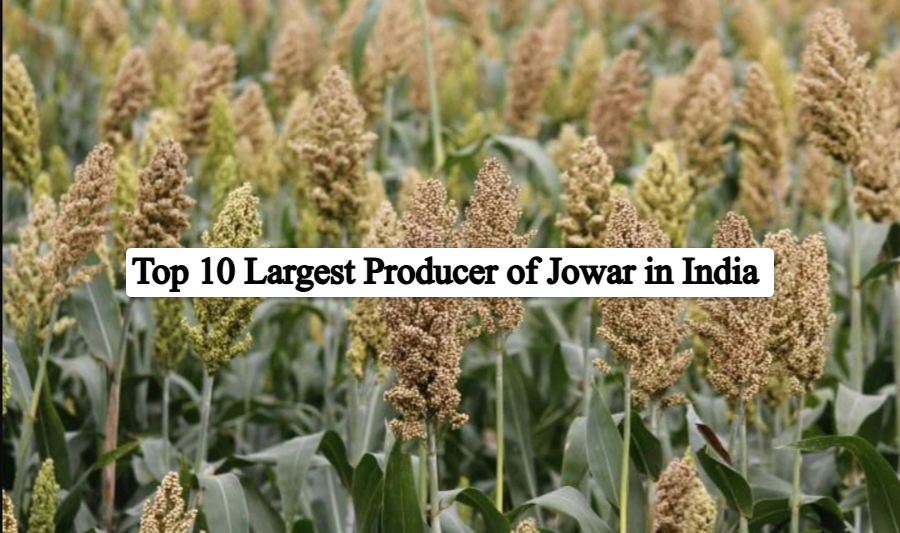
Top 10 Biggest Producer of Jowar in India
Read Time:6 Minute, 53 Second
In the midst of India’s semi-arid landscapes one crop is an emblem of endurance, nutrition sustainable development: Jowar (Sorghum). As we enter 2026 the growing focus on smarter agriculture that is climate-smart has propelled Jowar from being a quaint “coarse grain” to a highly sought-after superfood. India is the world’s leader in the cultivation of sorghum, which serves as a crucial source of food for humans as well as high-quality animal feed.
Jowar is a unique crop that flourishes when others have a tendency to wither. It needs only a little water, is tolerant of extreme temperatures, and is the gluten-free source of protein and fiber. To those who are an Indian farmer, it’s an excellent protection for the unpredictable rains that are a part of this century. If you’re looking for the major agricultural producers of Subcontinental India, this list of the top 10 largest producer of jowar in India will give you the necessary data-driven information.
1. Maharashtra: The Undisputed Sovereign
Maharashtra is more than one of the participants of the millet revolution. it is also the most prominent participant. Maharashtra is the biggest producer of Jowar in India with to nearly 50 percent of the nation’s production.
- Size of Production Maharashtra produces more than 14-15 lakh tonnes each year which covers a vast space in the region of 16 lakh acres.
- Regional Hubs These districts, Solapur, Sangli, Pune as well as Ahmednagar comprise the heart of the Jowar belt, in which this grain can be a diet staple, in the form of Bhakri.
- Dual-Season Advantage Contrary to many States, Maharashtra grows Jowar throughout both Kharif (monsoon) as well as Rabi (winter) times, providing a year-round supply.
- Support Systems Maharashtra’s state-run government been the first to offer subsidies for drought-resistant seed, which has consolidated Maharashtra’s position as the most prolific producer of Jowar across India.
2. Karnataka: The Southern Engine
Karnataka always holds the second place and its districts in the North-Eastern region serving as a key source of supply to the region.
- Production Output It is the state that contributes about 7.06 million tons in the pool of national resources.
- Principal Districts Vijayapura, Bagalkot, Dharwad, and Kalaburagi are associated with the highest-quality Jowar production.
- Food Legacy: in North Karnataka, Jowar is more than just a vegetable it’s a culture symbol, serving as the main base of local cuisine.
- Modern Shift While the acreage has seen an increase due to commercial crops the state is trying to revive production with the special Millet Missions.
3. Rajasthan: The Desert Warrior
The arid climate of Rajasthan is what makes Jowar the perfect suitable for its environment. It is ranked third, which proves that the most prolific producer of Jowar across India the title was a matter of perseverance.
- Arid Adaptation Rajasthan produces about 5.27 million tonnes and thrives in regions in which water is a rare quality.
- Livestock Backbone The Jowar region of Western Rajasthan, Jowar is equally valuable as an fertile, nutrient-rich feedstock that supports the state’s vast livestock and dairy industry.
- Bajra-Jowar Blend: While Rajasthan is the leading source of Pearl Millet (Bajra), Jowar is an important second crop to ensure food security.
4. Uttar Pradesh: The Diversifying Power
Most commonly recognized for its sugarcane and wheat, Uttar Pradesh has rapidly gained prominence by expanding into the nutri-cereals.
- Increase in Production: With an output of about 4.62 million tonnes, UP has moved to the fourth position.
- Bundelkhand The focus: The dry Bundelkhand region has been transformed into Jowar’s Jowar Capital of Jowar. the crops act as climate insurance policy for farmers in the area.
- The Government’s Push State has integrated milllets in the Public Distribution System (PDS) and is encouraging farmers to shift to Jowar.
5. Andhra Pradesh: The High-Yield Zone
Andhra Pradesh is a leader in the field of efficiency for agriculture, regularly reporting the most productive yields per hectare Jowar.
- Input Volume It is estimated that the state produces almost 2.93 lakh tons from only 84,000 hectares.
- Rayalaseema Belt: Districts such as Kurnool as well as Anantapur have been identified as the major producers, with a focus on local consumption as well as industrial production of starch.
- Technology Adoption: Farmers in this region use advanced seed management to increase yield even under rainy conditions.
6. Tamil Nadu: The Traditional Preserver
The Tamil Nadu’s Jowar manufacturing is deep embedded in the traditional food culture particularly in its dry areas.
- production: State produces approximately 2.8 lakh tons.
- Culinary use: Jowar can be used to prepare classic Dosa, Porridge and other snacks, keeping the local demand constant in markets.
- Regional Pockets Coimbatore, Madurai as well as Tiruchirappalli is the three main regions where Jowar is a popular option to replace rice.
7. Telangana: The Modern Millet Hub
Since its inception, Telangana has positioned itself as a leading modern manufacturer of millets, with a big emphasis on the processing process and adding value.
- Concentrated Cultivation: The state contributes substantially towards the nation’s pool and Adilabad along with Medak being the main production areas.
- Millet Clusters Telangana is establishing special clusters to help farmers turn Jowar in “ready-to-eat” products suitable for urban markets.
8. Madhya Pradesh: The Central Contributor
Madhya Pradesh acts as a important link in Jowar commerce between North as well as the South in India.
- Rain-fed Results: The state’s black soils provide the ideal water retention to Jowar and do not require extensive irrigation.
- Diverse utility: Much of the Jowar from MP is used in for the chicken feed business which uses it as a protein-rich substitute for maize.
9. Gujarat: The Commercial Maverick
Within Gujarat, Jowar is treated as a commercial crop typically, it is grown using efficient irrigation methods.
- Hybrid Seeds Gujarat is the pioneer in the use of hybrid Jowar cultivars that provide more resistance to disease and pests.
- Dairy Integration The state’s vast dairy cooperatives use Jowar stalks as their principal silage source, resulting in an ecosystem of high value for farmers.
10. Haryana: The Emerging Northern Force
Although Haryana is a relatively small geographically, its importance for the millet crop is increasing as farmers search for alternative options that aren’t water-intensive to their crop.
- Sustainable Shift Haryana encourages Jowar cultivation to help reduce sinking levels of groundwater in the southern districts of the state.
- High-Quality Grain This grain in this region is usually of top quality, coveted by the health food processing industry in the Delhi NCR region.
Why Jowar is the “Smart Crop” of 2026
What is it that makes the the largest producer of Jowar in India important for our future? It’s the versatility in the grain.
- Gluten-Free Pure: As celiac disease public awareness increases, Jowar has become the top option for healthier flour alternatives.
- The Climate Resistant: Jowar can withstand temperatures as high as 32 degrees Celsius and only requires 30 to 100 cm of rain.
- Soil Health Jowar is considered to be a “low-input” plant, which means it requires fewer fertilizers and chemicals to keep the soil healthy for a longer period of time.
- Value Added By 2026 Jowar can be converted to pasta, cookies or even packaging that biodegrades. This will boost its value on the market.
The Road Ahead for Jowar
Being the biggest producer of Jowar of jowar in India is an honour that carries responsibility. As climate change changes traditional patterns of rainfall states such as Maharashtra along with Karnataka are pioneering the way for the genomic cartographies of Jowar to produce more robust seeds.
- Bio-fortification New kinds of Jowar are being developed that have more Zinc as well as Iron levels to fight malnutrition.
- Ethanol Production Jowar stalks are utilized as a feedstock for biofuels of the second generation which adds industrial dimensions to the plant.
Conclusion
Indian’s agriculture destiny is changing thanks to these states. As Maharashtra is continuing to position as the biggest producer of Jowar in India however, the collective effort of all the states transforms this grain into a new success story. When we support Jowar it isn’t only supporting a crop; we are promoting the sustainable, healthy, and secure future for our planet.


Happy
0 %

Sad
0 %

Excited
0 %

Sleepy
0 %

Angry
0 %

Surprise
0 %
 0
0
 0
0
Average Rating