
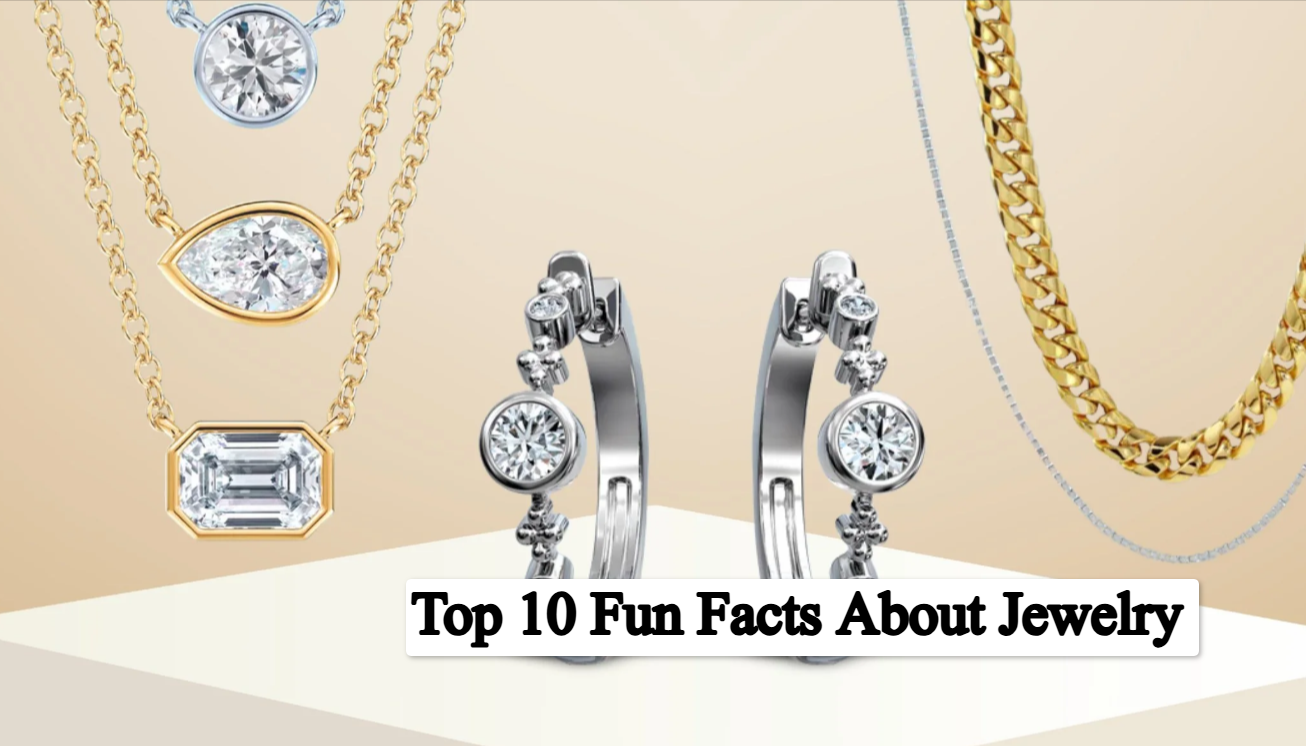
10 Fun Facts About Jewelry
Read Time:6 Minute, 33 Second
Jewelry is much more than an attractive accessory. It is a time-worn testament to our culture, a quiet telling of our past and a marvel of geoscientific research. In 2026, when we see an increase in minimalist sculpture in addition to laboratory-grown diamond technology the fascination for “bling” has reached an all-time level. From the depths that lies beneath the Earth to the runways of fashion of Milan Every metal and gemstone holds the secret of.
No matter if you’re a lover of antique gold or are a fan of contemporary silver stacks These insights will change your perception of the precious items in your jewelry collection. Be ready to be enthralled with these Top 10 Fun Facts About Jewelry that demonstrate that the most stunning things in the world usually have the most fascinating background stories.
1. Most Diamonds Are Billions of Years Old
Every time you see a diamond, you’re viewing a part of Earth’s history from the past. The majority of diamonds that are natural were created between 1 and 3.5 billion years ago.
- How it was made: They were forge under extreme pressure and heat, about 100 miles below Earth’s surface.
- A Journey They were laid on the ground via deep-seated volcanic eruptions that occurred millions of years ago.
- Interesting Facts: If you are wearing diamonds, you are literally wearing an “time capsule” that predates dinosaurs!
2. Gold is Literally “Out of This World”
Scientists believe that the majority of that gold discovered on Earth came to us via meteorite impact that took place millions of years ago.
- Stellar Origin It isn’t “made” on Earth; it is produced within the dying stars in the explosions of supernovae or collisions between neutron stars.
- Earth’s Core The majority of Earth’s original gold went into the core during its formation. The gold we use today was delivered by the cosmic “mail service” of space rocks.
- Keyword Insights: This makes gold jewelry one of the very few objects you own that truly alien.
3. The “Mona Lisa” of Jewelry: The Hope Diamond’s Blue Mystery
Hope Diamond Hope Diamond is perhaps the most renowned piece of jewelry on the planet and not just because of its 45.52-carat dimension, but also for its exceptional deep blue hue and its legendary “curse.”
- Its Science This blue color is due to tiny levels of this element Boron trapped within the structure of the crystal.
- The Glow In the short-wave ultraviolet light the Hope Diamond glows a fiery blood red the effect is believed to contributes to the mythology of the Hope Diamond having a “haunte” or curse.
- The 2026 perspective: Today, it is valued at more than $225 million even though it is considered “priceless.”
4. Pearls are the Only Gemstones Made by Living Creatures
Diamonds, as well rubies both created within the Earth, pearls are natural. They are created in the shells and mollusks, such as oysters and mussels.
- Self-Defense The pearl is formed when irritating agent (like grains of sand or parasite) is introduced into the shell. The mollusk coats itself with multiple layers of nacre (mother-of-pearl) to shield itself.
- The Cocktail Legend: It is believed that Cleopatra once disintegrated the priceless pearl in vinegar and consumed it to bet Mark Antony about who could hold an extravagant dinner in the history of the world.
5. Platinum is Rarer Than You Think
If all of the platinum ever extracted throughout human history was placed in a water pool, it could only be able to cover your ankles.
- The scarcity of Platinum is markedly more rare than gold. It is estimated that 10-ton of platinum ore need to be mined in order to make just one ounce pure platinum.
- durability: Due to it being extremely strong and dense it is the most preferred choice in wedding rings that must hold precious stones in a secure way for the rest of their lives.
6. Rubies and Sapphires are “Siblings”
A lot of people don’t know they are rubies and sapphires are the exact same mineral. The mineral Corundum.
- The color factor If the mineral’s color that is colored red, you refer to it the ruby. Each other color (blue yellow, pink, green) is categorized as sapphires.
- Chromium Magic The only thing that transforms the sapphire into ruby is the element Chromium.
- 2026 Trend “Parti-sapphires,” that display two or more colors within one stone is a current trend in custom-made jewelry.
7. The World’s Largest Diamond Was the Size of a Heart
The Cullinan Diamond was found in 1905 is the largest rough diamond of gem quality ever discovered. Its weight was staggering 3106 carats (about 1.37 pounds).
- The Cutting: The HTML0 was later divided into nine large stones, and 96 smaller ones.
- The crown jewels It is the biggest cut of the crown jewels, that of Cullinan I (The Great Star of Africa) is set within the British Sovereign’s Sceptre. It is weighed more than 560 carats..
8. Amber is Actually Fossilized Tree Resin
As opposed to the other “stones,” amber is a fossilized resin derived of ancient evergreen trees.
- Time Travelers: Because it was once a sticky liquid, amber often contains “inclusions”–perfectly preserved insects, leaves, or even small feathers from millions of years ago.
- warmth: Unlike most gemstones which feel cold to feel, amber feels surprisingly warm because it’s a very poor heat conductor.
9. The “Engagement Ring” Tradition Started in 1477
The concept for the idea of a “betrothal ring” dates back to the time of ancient Rome The first documented jewelry piece of engagement diamonds was presented to archduke Maximilian from Austria to Mary of Burgundy in 1477.
- The symbol: He placed diamonds in the form that of the letter “M” to represent her name.
- marketing power: Modern “rule” that the cost of an engagement ring is two months’ wages was actually a hugely effective advertising campaign run by the company De Beers in the 1940s.
10. 2026: The Rise of Lab-Grown Luxury
By 2026 laboratory-grown diamonds are officially transitioning from “tech curiosity” to a popular luxury option.
- Similar Physical properties: They aren’t “fake” diamonds; they are physically, chemically, and optically the same as mined diamonds.
- Ethics and Value: Since they’re created in a laboratory employing CVD (Chemical Vapor Deposition) or HPHT technology, they can be 30 to 40 percentage cheaper and leave less environmental impact.
- A New Future It is creating designers with the ability to design massive, maximalist jewelry pieces that were once impossible for the average person to afford.
Jewelry Care: 3 Tips for 2026
After you have learned these fascinating details about jewelry Here’s how you can keep your jewelry shining:
- The “Last On, First Off” Rule: Always put your jewelry on immediately after applying hairspray or perfume to protect yourself from damaging chemicals. It is best to remove it when you return back home.
- Ultrasonic Beware: Never put Opals, emeralds as well as pearls in an ultrasonic cleaner. The vibrations could shatter or harm the delicate stones.
- Soft Storage: Store your diamonds separately. Diamonds are the strongest natural material, they could effortlessly scratch silver, gold and the rest of your gemstones..
Conclusion: Wear Your Story
Jewelry is the sole art form we can wear on our bodies. No matter if it’s the meteorite necklace from outer space or the gemstone of the sea Your jewelry connects you with nature and the evolution of human craft. The Top 10 Fun Facts About Jewelry will show that underneath every glitter is a tale that is a tale of ancient oceans, cosmic collisions as well as romantic gestures.
As we consider our future in environmentally sustainable luxurious The “value” of jewelry is getting less concerned with the cost and it is more concerned with the purpose and significance of the item.


Happy
0 %

Sad
0 %

Excited
0 %

Sleepy
0 %

Angry
0 %

Surprise
0 %
 0
0
 0
0

Average Rating