
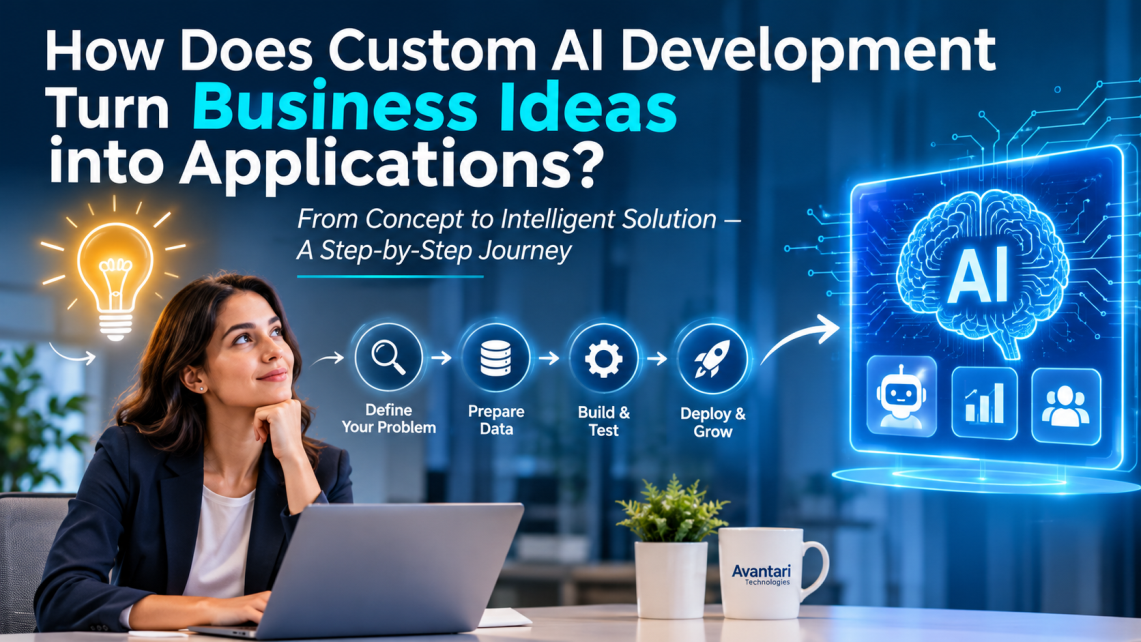
How does custom Ai development turn business ideas into Applications?
Read Time:7 Minute, 57 Second
Artificial intelligence is making software development an increasingly important part of modern software development. Companies are increasingly leveraging AI to improve workflows, analyze data, and add new features to digital products. Artificial intelligence can assist with smart search, automated document processing and everything in between.
But taking an idea and turning it into a working AI application takes some planning. Before applying any technology in the real world, businesses need to understand the problem, find the right data, choose the right technology, and evaluate the application.
Organizations can understand business requirements and build solutions around specific use cases to explore real life applications of artificial intelligence.
What does Custom AI development mean?
All AI projects begin with a business idea or a problem that needs solving. The idea could be to add smart functionality to software, to improve an existing process or to create a new digital product.
Custom AI Development is the process of building AI-powered applications tailored to specific business needs. It could be machine learning, natural language processing, generative AI, computer vision or other artificial intelligence (AI) technology.
Custom AI apps, as opposed to general purpose AI tools, are designed to do one specific thing. Features, data sources, integrations and evaluation methods are tailored to the respective use case.
Say a company wants to build an app to allow its employees to search internal documents. Another organization might want an AI-powered feature that analyses images. The two ideas will need different technical solutions.
The first thing is to determine what you want the application to do and if AI is the right tool for the job.
Step 1: Understand Business Problem
Before businesses can build an AI application, they need to know what problem they want to solve. Having a clear goal will help guide the development and will reduce the chances of adding unnecessary features.
Teams should ask themselves:
- What problem is the app addressing?
- Who will use the application?
- What’s it meant to be doing?
- What information is required?
An e-commerce business, for instance, might want to help users search for products and get more relevant results. Company producing something can want to do image-based inspection on some manufacturing process.
“The requirements of these apps are different.” Understanding the business problem helps to point development in the right direction.
Step 2: Data and Technical Feasibility Evaluation
A lot of AI application is data. Depending on the use case, the system may need documents, images, customer interactions, operational records or other information.
Before starting development, the team should think about data availability, data quality, data format and data usage permissions.
Inconsistent or incomplete data can affect artificial intelligence systems. Data may need to be cleaned, organized or otherwise prepared, depending on the project, before the information can be used.
And it has to be technically feasible. Companies have to think about whether the proposed application can be built with the resources, infrastructure and project constraints they have.
This is a good way to set expectations and identify any potential barriers early on.
Step 3: Choose the Right AI technology
Each business idea doesn’t require the same artificial intelligence (AI) technology. The choice of the approach should be driven by the problem, the data available and the functionality desired.
Machine Learning
Machine learning enables systems to detect trends in data and then to predict or classify. It can be used for anomaly prediction and customer Segmentation
Natural Language Processing
Natural Language Processing is the ability of the software to understand human language. It can be used for document analysis, text classification, intelligent search, and conversational interfaces.
Generative AI
Generative AI makes use of the user’s prompts and context to produce text, summaries and other output. This is something businesses may want to consider for knowledge assistants, content workflows and AI-powered software features.
Computer vision
Computer vision is the ability of software to understand images or video. They can be used for image classification, object detection and visual inspection.
A custom AI development company can evaluate these options and help to choose a strategy that fits the project requirements the best.
Step 4: Plan the application architecture
The next step after defining the use case and the AI approach is to plan how the app will work.
Application architecture describes the major components of a system and their communication. Depending on the project, it may include
- UI Design
- back-end app
- Data Storage
- API & Integrations
- Security / Access control
- Things to evaluate and monitor
For example, an AI assistant embedded in a business platform may need to access authorized data sources and deliver the answers through the existing user interface.
Thinking about the architecture ensures the AI feature can be integrated into the larger software environment.
Step 5: Build and Test the AI Application
In the development phase, the team develops the AI parts and the software that supports it according to the requirements.
This can include data preparation, setting up or creating the model, building the application interface and integrating the required systems.
Testing is a big part of the process.” “We’d like to see how the AI applications measure up to certain standards.
Tests may include:
- Quality & accuracy of outputs
- Application performance
- User experience dependable
- Data Processing
- Handling unexpected input
Generative AI applications evaluation must include incorrect or unsupported responses. Depending on the use case, a human review may be needed.
A structured testing process can uncover limitations before the app is released to the intended users.
Step 6. Embed the app into business processes
An AI application can be a product itself, or can be embedded in a pre-existing website, mobile app or software platform.
Integration is connecting the AI capability to the systems and processes the AI is intended to support. It could be APIs, database connectivity, user authentication, or any other part of the software.
For example, a document processing AI app may need to connect to a company’s document management system. The AI-powered search feature may have to work within the constraints of an existing website.
Depending on the technical environment and the expected user experience, integration can be performed in different types.
Step 7. Deploy, Monitor, and Optimize
After the application has been developed and tested, it can be released to the users for whom it was designed.
Planning for deployment may involve establishing infrastructure, access management, and documentation and user guidelines. After the application is deployed, monitoring is done to find out the issues and to test the performance.
An artificial intelligence system may need to be updated as data, user needs or business processes change. Monitoring helps to know if more tests or adjustments are needed.
Applications that need to change information or output for users should be assessed on a continuing basis.
How Can Custom AI Development Company Help Business Ideas?
Custom AI development companies can help you in different stages of your AI project, from understanding the idea to building and integrating the application.
This can include requirement analysis, data assessment, technical planning, AI development, software integration, testing and maintenance.
If you are a business looking at your development needs and possible technical routes for AI-powered digital products you might want to take a look at Avantari Technologies. Companies should know their use cases, data needs and desired outcomes before choosing a development partner.
In a good partner you have to look at the technical approach, communication, testing and understanding of the business problem.
Common Problems When Building AI Applications From Ideas
AI development can be hindered by data, technology, integration and performance issues.
If you lack the data you need or you are unsure of how to clearly define the problem, then an AI business idea might not be a good fit. Testing and monitoring is also important, because artificial intelligence systems can produce the wrong results.
There may be some extra planning to interface with existing software. Other business considerations are privacy, security, operating costs, and human supervision.
Including these in the planning stage will enable organizations to make informed decisions and set realistic expectations for the project.
Conclusion
The journey from business idea to AI application is a multi-step process: problem identification, data evaluation, technology choice, architecture design, development, testing, integration and monitoring.
A custom AI development company can help businesses navigate these stages and build apps according to the specific needs. But the value of an AI solution is the value of the solution to the problem it is supposed to solve and how carefully it is evaluated.
With a clear goal and a clear path of development, companies can deliberately determine how to apply artificial intelligence in their products and operations.
FAQ Frequently asked questions
How to Develop an App from an Idea Using Custom AI?
The technologies might include machine learning, natural language processing, generative AI and computer vision. The choice is dictated by the application.
Can I add AI to an existing software product?
Yes. AI functionality can be integrated into existing websites, mobile applications and software platforms where technical requirements allow.
What is the first step in AI project development?
Step 1: Identify the Business Problem and Desired Outcome This way you can see what the app is supposed to do, and if AI is right.
What makes it so important in the development of AI apps?
It’s to see how well the application works, to find mistakes and limits, to see if it needs more safety steps or a person to look at it.”


Happy
0 %

Sad
0 %

Excited
0 %

Sleepy
0 %

Angry
0 %

Surprise
0 %
 0
 0

Average Rating