
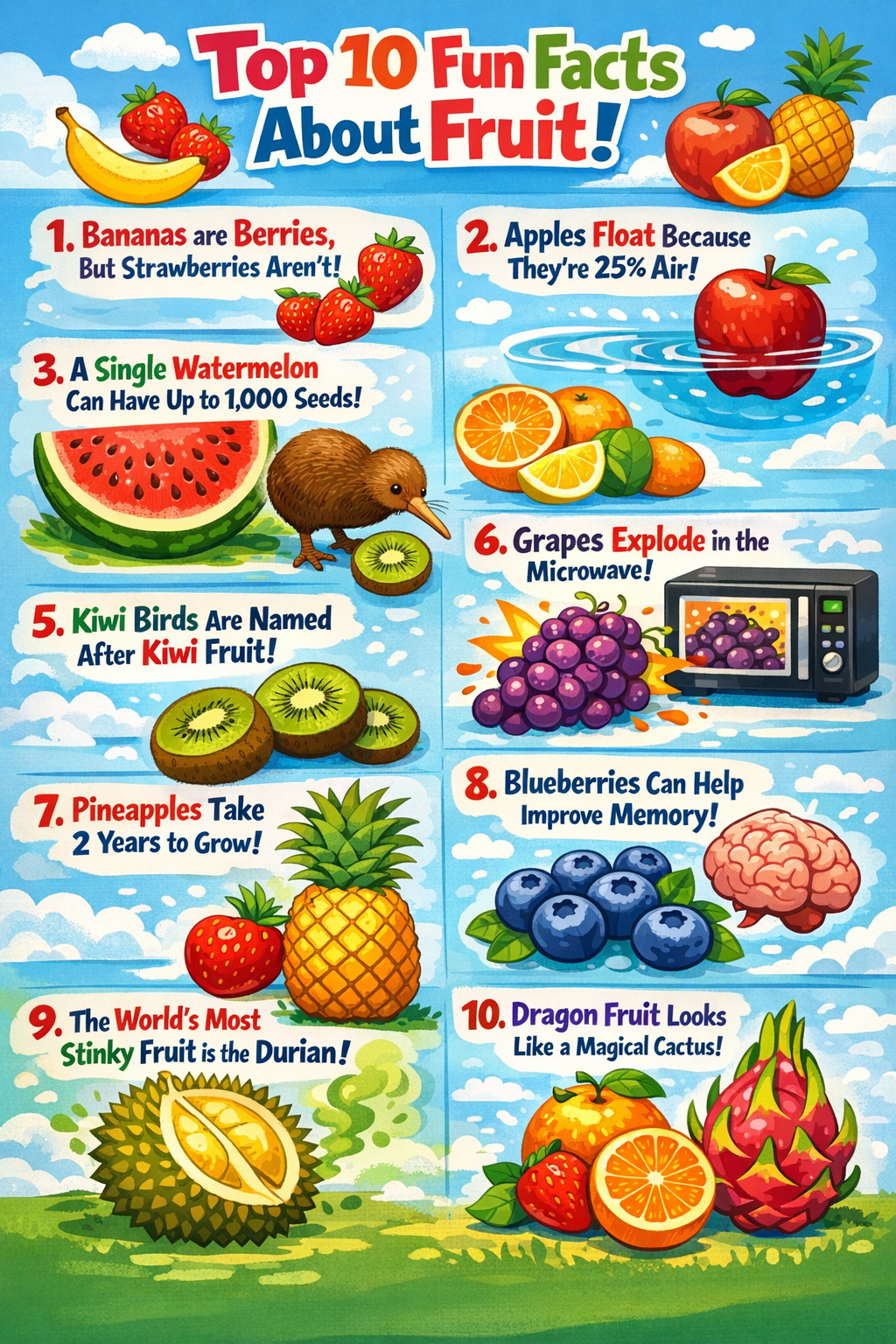
10 Fun Facts About Fruit
Read Time:6 Minute, 51 Second
Fruit is the perfect fast food. It’s sweet, pre-packaged and packed with vital nutrients. But have you taken the time to consider the food you’re actually eating? Beyond the vitamins and fiber the world of agriculture and botany is full of information that can alter your grocery shopping habits for good.
In this complete guide, we’ll peel off the skin of the top 10 fun facts about fruit. From “berries” which aren’t fruits to fruit that make meat more tender, these findings show that nature is more intelligent than we think it is for. These interesting facts about fruits are intended to make you look like the smartest person around dinner!
1. Strawberries and Raspberries Are Not Berries
It’s like a botanical mistake, but in the realm of science the names we use to describe fruits can be in conflict with their real classification.
- The Scientific Definition: A “true” fruit is one that has been cultivated from one ovary of one flower. It has 3 distinct layers.
- The Aggregate Effect: The strawberries and the raspberries are the aggregate fruit. They originate from one flower with many different ovaries.
- Seed Placement: Have you seen that little “seeds” that are on the exterior of the strawberry? These are actually the fruits and the red part that we eat is actually the container of the flower!
2. Bananas, Watermelons, and Pumpkins ARE Berries
Although strawberries don’t pass the “berry test”,” certain of your most-loved large foods pass it in a breeze. This is among the amazing facts about fruit that typically will leave people speechless.
- Single Ovary: Bananas are born from a single ovary, and contain a soft middle as well as seeds (even even if they’re tiny and non-sterile for commercial variety).
- Peel protection: Because they meet all botanical requirements, bananas, watermelons and even cucumbers technically are berries.
- the Banana Curve: Bananas expand against gravity towards the sun, a process known as Geotropism that is negative and is the reason they are famous for their curved form.
3. Pineapples Can “Eat” You Back
Have you ever felt the sensation of a tingle or burning sensation on your tongue after eating a large amount in fresh fruit? It’s not an allergy, it’s an inflammatory reaction.
- Bromelain’s Power: Pineapples contain a powerful enzyme, called bromelain.
- Protein Digestion: Bromelain breaks down proteins. When you chew a piece of pineapple the enzyme begins breaking down the proteins that are on your tongue as well as on the tongue’s roof.
- Meat Tenderizer: This is precisely why the juice of pineapple is used as an naturally-made meat tenderizer when cooking. However, don’t be concerned about it because your stomach acid will neutralize the enzyme immediately after you ingest!
4. Apples Float Because They are 25% Air
If you’ve ever been “bobbing for apples” you’ve probably noticed that they sit at the top in the ocean. This isn’t due to them being lightweight, but due to the inner structure.
- Air Pockets: Around one-quarter the volume of an apple is air. This makes the apple less dense than water.
- Variety matters: There are over 7,500 varieties of apples that are grown all over the world. If you consumed a new apple every single day it would take around 20 years to experience every one!
- The Rose Family: The apple, as well as plums and pears, are all part of the Rosaceae (rose) family..
5. Tomatoes are the World’s Most Popular Fruit
While we usually think of tomatoes as vegetables for sauces and salads however, they are botanically fruit. In particular they’re the highest eaten “fruit” in the world.
- World Production: This is the only place in earth that produces more than 180 million tonnes of tomatoes every year.
- Lycopene Source: They are renowned as a major source of Lycopene an antioxidant that is powerful which is more effective when tomatoes are cooked.
- Legal debate: In 1893, the U.S. Supreme Court legally classified the tomato as a plant for customs and tax purposes even though scientists claimed that it was actually a fruit!
6. The “Orangutan” of Fruits: The Durian
Also known by the name of “King of Fruits” in Southeast Asia, the durian is known for only something else: it’s scent. It’s one of the most controversial interesting facts about fruit available.
- The smell: the smell durian is described as a mixture of decaying onions, turpentine and raw sewer.
- A Ban: Since the smell remains so strong and persistent durians are prohibited from numerous establishments and even public transportation in countries such as Singapore in the Philippines and Thailand.
- Its Flavor: In spite of the scent the flesh is smooth and sweet. It is often it is compared to an custard made of almonds.
7. Pomegranates Can Contain Up to 1,400 Seeds
The pomegranate has been a long-standing symbol of prosperity and fertility when you examine one it is clear the reason.
- The arils: Red juicy pieces you eat are known as arils.
- The count: On average, the pomegranate itself contains between 600 – 1,400 seeds.
- Superfood status: These superfoods are loaded with punicalagins which are extremely potent antioxidants that aid in maintaining the health of your heart and lessen inflammation.
8. Cranberries Bounce Like Rubber Balls
If you’re looking to find out whether a cranberry has been picked fresh and not spoiled, you don’t have to taste it. All you need is be able to shake it. This is one of the most common interesting fact about the fruit that farmers use for sorting their crops.
- Air Chambers: Cranberries that are fresh have tiny air pockets in them.
- the Bounce Test: A healthy firm, firm cranberry will bounce off a wooden wall, while an rotting or bruised one will just hit the floor.
- Wet Harvesting: The cranberry swamps are often flooded by farmers since the air pockets in the cranberries make them floated, making easy for them to “comb” the cranberries off of vines.
9. Figs Aren’t Technically Fruit–They Are Flowers
It is possibly the most complicated botanical mystery within the gardens. If you consume an fig, you’re really eating an upside-down flower.
- Internal Blooms: “The “fruit” can be described as a bulb that contains hundreds of tiny blooms that appear within the pod.
- Wasp Symbiosis: Since the flowers are inside, they require a particular wasp called a fig to enter the tiny opening for pollination.
- Eco-Cycle: The wasp will be processed through enzymes (ficin) much before the fig gets to your plate, and becomes part of the fruit’s nutritional value!
10. The Dark Secret of the Seedless Watermelon
Did you wonder how to get “seedless” fruit when there aren’t any seeds to plant to produce our next crop? It’s all about some sophisticated gene crossing.
- Chromosomes: Watermelon seeds have the designation of “triploid.” The were produced through crossing plants that has four chromosomes, and a plant with two.
- Sterility: Its resulting crop has three chromosomes making it sterile and unable create mature tough black seeds.
- Pollination: The farmers must still plant “normal” watermelons in the vicinity to supply the pollen which “tricks” the plant without seeds into producing fruit.
Why Fruit Facts Matter in 2026
In 2026, we’re witnessing a major shift towards the plant-based diet and “functional food items.” Knowing these fascinating facts about fruit can help us understand the complex nature that is our system of food. It doesn’t matter if you’re using pineapple for digestion, or picking pomegranates for an increase of antioxidants The fruits we consume are an effective way to prolong our lives.
Changes in climate change affect where and how we cultivate our food, these resilient and amazing species are continuing to evolve. The more we understand about them, the more we can safeguard the diversity of our natural orchards.
Conclusion
The bouncing cranberry all the way to the flesh-eating pineapple The world of fruits is an amazing and fascinating place. The top 10 fun facts about fruit are only the beginning. When you next walk through the aisle of produce, remember that you’re not just taking a look at the snacks you buy; you’re taking a look at the millions of years of the evolution of humankind.


Happy
0 %

Sad
0 %

Excited
0 %

Sleepy
0 %

Angry
0 %

Surprise
0 %
 0
0
 0
0


Average Rating