
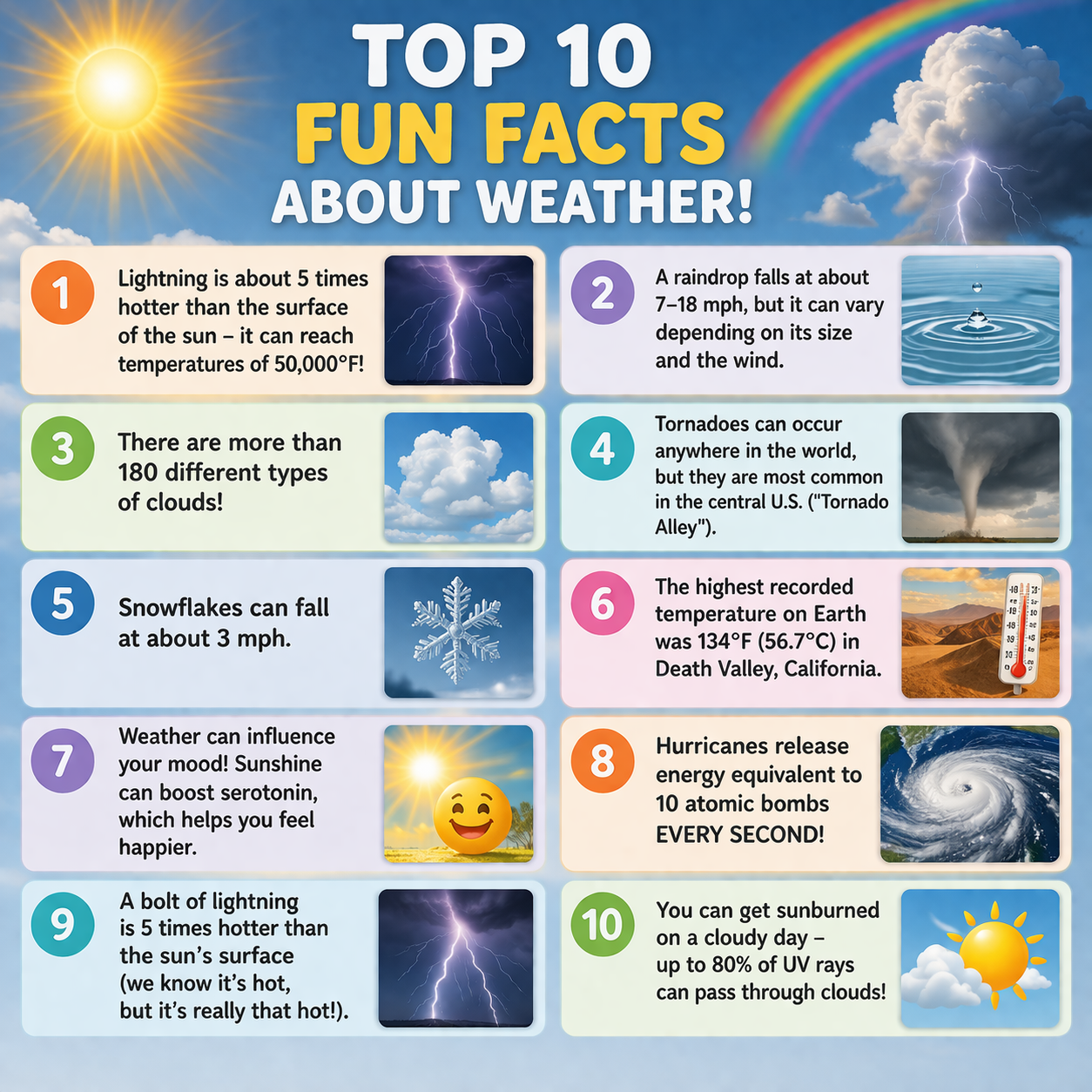
10 Fun Facts About Weather
Read Time:7 Minute, 14 Second
Weather is the most popular conversation starter, however most of us go to the forecast to find out whether we require an umbrella. Below that surface “sunny with a chance of rain” is a tangled beautiful, awe-inspiring, and a terrifyingly strong system that is in charge of each and every minute that we live. From volcanoes that blaze to animal rain The atmosphere is a stage of the strange.
In this in-depth look into the most interesting 10 information about the weather that go beyond what you see on the news. If you’re interested to meteorology or extreme climate events or simply wish to impress your fellow guests at your next dinner party This knowledge of the Earth’s atmosphere can change the way you see a gray sky for ever.
1. Lightning Is Five Times Hotter Than the Sun
When we witness an explosion of lightning, we’re witnessing one of the most powerful energy releases that occur in the natural world. While the surface of sun is extremely hot, one bolt from lightning can make it appear cold when compared.
- The Temperature The lightning bolt could reach temperatures of around 30000degC (54,000degF).
- solar comparison: Its solar surface is “cool” 5,500degC (10,000degF).
- Rapid Expansion The extreme heat creates that the surrounding air to expand rapidly and this is precisely what causes the sound waves we hear as thunder..
- Glass making: When lightning hits the sand, the heat becomes intense enough to melt the silica into glass tubes, also known as Fulgurites commonly called “petrified lightning.”
2. The “Rain of Animals” Is a Real Phenomenon
It’s like something from the pages of a mythological creature However “raining animals” is a well-documented meteorological phenomenon. In the past there have been numerous reports of frogs, fish and even octopuses descending from the skies.
- Waterspouts This is typically an waterspout–a tornado that is formed over water.
- The vacuum effect These vortexes could trap small fish to the cloud.
- Cloud transport: The animals are transported by powerful updrafts for miles until the wind dies down, which causes them to “rain” over unsuspecting inland towns.
- Lluvia de Peces: In Yoro, Honduras, this is so frequent that they’ve got an annual festival known as “Lluvia de Peces” (Rain of Fish).
3. A Cloud Can Weigh More Than a Million Pounds
Clouds appear like airy, light-weight cotton candy floating in the wind. They are actually huge clouds of water droplets as well as crystals of ice that hold enormous amounts of atmospheric mass.
- It’s the math: The average cumulus cloud (the puffy, white cloud) is approximately one kilometer in length and has an average density of 0.5 grams for each cubic meters.
- The Weight Total: That means that single cloud with a size of medium weighs approximately 500 kg (1.1 million pounds).
- Why aren’t they falling? They stay afloat because their weight is spread across a vast area, and warm air that rises out of the earth (updrafts) keep them in suspension like dust motes that are suspended in sunlight.
4. Antarctica Is the Dustiest, Windiest, and Driest Place on Earth
We normally think of “dry” with the Sahara Desert However, the name for the driest location is actually a reference to Antarctica, the continent with ice. Antarctica.
- The Dry Valleys: Parts of Antarctica’s McMurdo Dry Valleys haven’t had a drop of rain, or a snowflake for nearly 2 million of years.
- Katabatic Winds The continent is a victim of “katabatic winds,” which occur when dense, cold air rushes through mountainsides at speeds of 350 kilometers per hour (200 more mph).
- Polar Desert: Because the air is cold, it is unable to retain moisture and is an “cold desert.” It is more dry than the center of Atacama Desert of Chile.
5. You Can Hear the Weather Coming (With Crickets)
Don’t think about high-tech satellites for weather for a second. If you’re looking to find out what temperature it will be, all you require is a stopwatch, and a cricket that is chirping.
- Dolbear’s Law Created in 1897, this law explains that frequency and duration of tree that is snowy cricket’s chirps are directly linked to the temperature of the surrounding air.
- This Formula The number of times you chirp you hear in 15 minutes and then multiply by 40 to determine temperatures in degrees Fahrenheit.
- Biothermometer: Since crickets are cold-blooded chemical reactions (and therefore their muscles actions) increase as the temperature increases and slows down when it gets cooler.
6. Dirt Is the Secret Ingredient for Rain
You’ll be surprised by the fact that you can’t have a rainstorm without a bit of “junk” in the air. Pure water vapor doesn’t transform into rain by itself.
- Cloud Condensation Nuclei Rain requires an un-shakable surface to cling to. The “surface” is usually a tiny small speck of dust or smoke, salt and even bacteria.
- The process: Water vapor clings to the particles, getting bigger in weight until gravitation pulls them downwards as raindrops.
- Cloud Seeding That’s why researchers make use of clouds to seed–spraying silver iodide on clouds in order to “trick” the moisture into creating rain during dry spells.
7. The Earth Experiences 2,000 Thunderstorms Simultaneously
Although it may be a sunny, calm day at the moment you’re sitting however, the Earth in general is constantly in a state of electrical chaos.
- The Global Circuit: At any given time there are around 2 000 storms taking place all over the world.
- Lightning Strikes This results in around 100 lightning strike every second that’s 8.6 million strikes per day.
- Energy Output The energy produced by one big storm can be as powerful as an tiny nuclear bomb and yet it happens hundreds of times per hour.
8. Snow Is Not Actually White
If you examine a snowflake through a microscope, it won’t show an opaque white flake. It is actually transparent (clear).
- Light Scattering Snow is made up of crystals of ice. When light strikes an crystal of ice, it doesn’t go straight through it; instead, it bounces off the various faces and surfaces of the snowflake.
- The Spectrum The light reflected in such a uniform manner throughout the spectrum of colors Our eyes interpret the result as white.
- The Deep Blue snow: When glaciers or snow banks are very thick, snow appears blue because the layers in the depth absorb light from red and reflect it back into blue.
9. Hurricanes Can “Breathe” and Create Their Own Weather
An storm (or Typhoon) is the biggest storm system on earth and functions as a living organism.
- The Heat Engine Hurricanes function by sucking humid and warm air from the surface of the ocean and exhaling it at high altitudes.
- Eyes: The tranquil “eye” of the storm is actually caused by the air sinking to at the very top. This reduces cloud formation and produces a an eerie, peaceful center.
- Tornado Spawning The large storms can be so powerful that, when they strike land, the friction created by the ground creates an air “tumble,” often spawning hundreds of mini-tornadoes in the rain bands.
10. Strange “Red Sprites” Dance Above the Clouds
For decades, pilots reported seeing weird, reddish glows above massive thunderstorms, but scientists dismissed them as “hallucinations”–until they were finally caught on camera in 1989.
- Red Sprites These are huge electrical discharges that take place over the storm and can extend as far as 90 km (55 miles) into the edge of space.
- Jellyfish Shapes They usually look like huge red jellyfish, with long, dangling tentacles that white.
- Elves as well as Blue Jets: Along with sprites, there’s “Elves” (flat, expanding glowing) along with “Blue Jets,” proving that the air above is like the air that we breathe on earth.
Why Weather Facts Matter in 2026
As our global climate alters and we learn to recognize the extreme patterns of weather is now a vital survival capability. From climate changes altering the intensity of hurricanes, to the manner we make use of renewable energy sources (like solar and wind) The weather is the most important element of our future economic and security.
The more we understand about these atmospheric marvels and the more we will be able to prepare for a future where “unprecedented” weather becomes the new norm.
Conclusion
The sky isn’t just empty space. It is the perfect laboratory for the sciences of physics, chemistry and pure amazement. These interesting facts about weather demonstrate that even on a boring, grey Tuesday there’s an eerie million-pound cloud over you and a cricket-thermometer in your vicinity and a worldwide electrical circuit that is powering the globe.


Happy
0 %

Sad
0 %

Excited
0 %

Sleepy
0 %

Angry
0 %

Surprise
0 %
 0
0
 0
0


Average Rating