
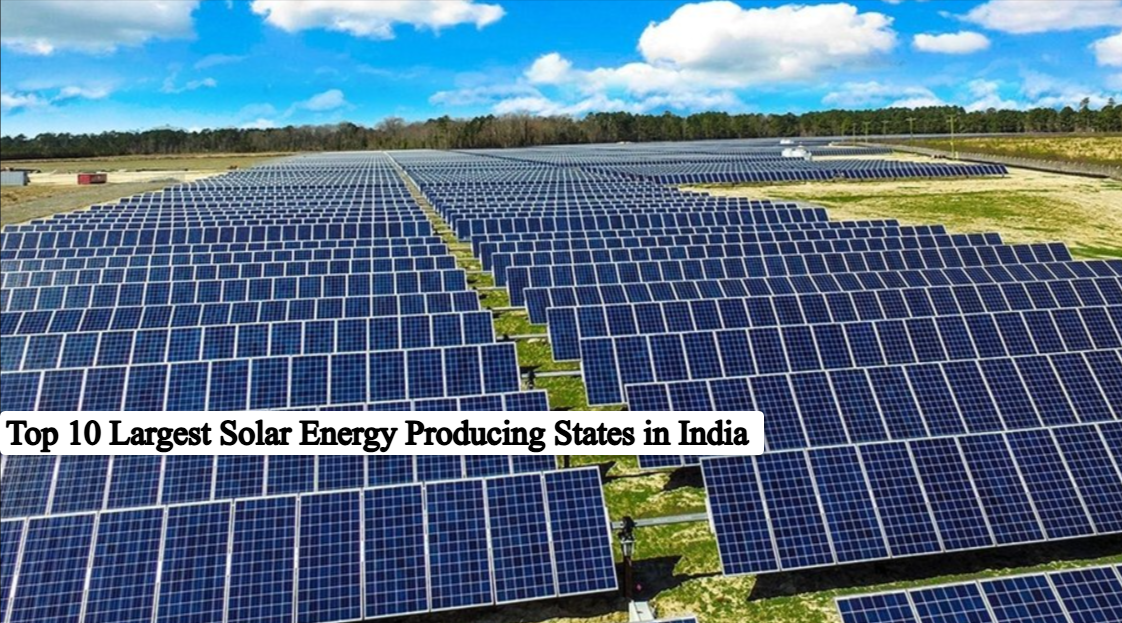
10 Largest Solar Energy Producing States in India
Read Time:6 Minute, 59 Second
In the year the year 2026, India has officially confirmed its position as a green energy powerhouse. With a staggering solar capacity that exceeds 150 gigawatts the country has not just reached it Paris Agreement targets years ahead of schedule, but also transformed its vast expanses of land into “temples of green energies.” In the desert, from scorching hot sands in the Thar desert to lush prairies in Deccan solar panels have become permanent fixtures of the Indian landscape.
The transition to renewable energy isn’t simply a necessity for the environment but is now an important economic driver. In this complete breakdown, we look at the top 10 largest solar energy producing states in India. These states were the pioneers of”Surya Shikti,” also known as the “Surya Shakti” movement, which combines enormous utility-scale parks with creative rooftop plans. If you’re looking to find out which region is the one that holds the crown as the largest solar energy-producing states in India You are at the right spot.
1. Rajasthan It is the Sun The King Of India
Rajasthan remains on the title of the biggest solar energy producing state of India. with more than 28.7 billion GW of capacity installed, the state is responsible for a significant portion of India’s solar energy footprint.
- Bhadla Solar Park: It is located in Jodhpur it is the world’s biggest operating solar park that covers 14000 acres with the capability in excess of 2.45 MW.
- Ideal Irradiation Thar Desert: Thar Desert provides some of the highest levels of solar irradiation around the globe, making it a gold mine in the natural environment for energy.
- Economic impact: Large-scale projects have transformed “wastelands” to high-value areas, creating thousands of jobs locally in the fields of maintenance and robotics.
- 2020 Milestone It is the first time that the state gone beyond utility parks to concentrate in the solar and wind hybrid projects to guarantee an uninterrupted power supply.
2. Gujarat The Hybrid Powerhouse
Gujarat has experienced a rapid increase in its energy production, and is now the second position, having a power capacity of 19.4 Gw. It is developing the world’s biggest solar energy power plant in Khavda.
- Khavda Project: This huge hybrid park within Kutch’s Rann of Kutch is slated to be thirty GW (solar and wind) it is a marvel of engineering that is visible from space.
- Rooftop Leadership Gujarat is still the most popular State in the country for roof solar installations, with more than 3.800MW generated by commercial and residential rooftops.
- Canal Solar: The state was the pioneer of “Canal-top” solar projects that produce electricity and reduce the loss of water from irrigation canals.
3. Karnataka The Innovation Hub
Karnataka was among the states that first crossed the 5 GW threshold and has a current capacity of 9.6 GW of solar energy production.
- Pavagada solar park: Also known as Shakti Sthala, this 2,050 MW solar park is well-known because of the “land-lease” method, in which farmers own the land and pay rent to ensure rural prosperity.
- Technology Adoption The state incorporates the latest AI-driven grid management in order to balance its high proportion of wind and solar energy.
- Future Expanding: The Karnataka government recently announced plans to add an additional 3GW to its existing parks.
4. Maharashtra Maharashtra: Industrial Green Giant
Maharashtra has taken over various states to take the fourth spot with more than 11.1 billion GW of power capacity. Its primary focus is focused on “decentralized” energy to power its huge industrial clusters.
- Solar Villages Manyachiwadi situated in Satara district in Maharashtra recently became Maharashtra’s very first village completely solarized.
- Agri-Solar State is an innovator on the PM-KUSUM implementation by providing the farmers with solar-powered pumps in order to reduce their dependence on traditional grid.
- Open Access Maharashtra has the lead on “open access” solar power, allowing private companies to purchase solar energy straight from solar developers.
5. Tamil Nadu: The Integrated Leader
Tamil Nadu remains a heavyweight in the field of renewables by having 10.3 gigawatts of capacity for solar. It’s unique because of its balanced mixture of solar and wind.
- Kamuthi solar Plant: At one time, the world’s biggest single-location solar plant, Kamuthi remains to be an amazing feat of speedy execution (built in only 8 months).
- Distributed Energy This state has been looking at solar parks for district-level use to decrease transmission losses and to empower local municipalities.
- Grid Stability Thanks to the huge wind power, Tamil Nadu is a pioneer in the management of this “intermittency” in renewable power.
6. Andhra Pradesh: The High-Speed Executor
With 5.4 gigawatts in capacity Andhra Pradesh is known for building super-mega solar parks at a record pace.
- Kurnool Ultra Mega Solar Park: This 1,000 MW park was completed in just two years, showcasing the state’s ease-of-doing-business in the energy sector.
- Kunta Park: Another huge construction in Anantapur which supports an industrial corridor in Anantapur.
- integrated storage: The state is currently establishing some of India’s biggest pumped hydro + solar Storage projects.
7. Madhya Pradesh: The Heart of Solar
Madhya Pradesh has made significant advancements, with an output in the range of 5.1 billion gallons. It is the home of many of the most famous construction projects within Central India.
- Rewa Solar Project: This project of 750MW was one of the first projects in India to reach “grid parity” (costing less than coal) and is the one that is the source of power for Delhi Metro.
- floating solar: MP is home to one of the largest floating solar projects located in the Omkareshwar Reservoir, saving land and reducing the amount of water that evaporates.
8. Telangana It’s the Urban Solar Pioneer
Telangana is a prominent presence thanks to 4.8 gigawatts of solar power. The state is focusing heavily on integrating solar power into its rapidly expanding IT hubs.
- Ramagundam floating Solar: A 100 MW floating solar plant that serves as a reference for using water bodies to boost energy production.
- Policy Support This state’s “Single Window Clearance” has brought in massive private investment from solar developers.
9. Uttar Pradesh: The Sleeping Giant Awakes
Uttar Pradesh is the fastest-climbing state on this list, with a current capacity of 3.3 Gw however it also has the largest pipeline of projects that are scheduled to start located in North India.
- Bundelkhand Solar Circuit Massive areas of land located in Bundelkhand are being converted into solar hubs. Bundelkhand zone are transformed into solar hubs in order to boost regional development.
- Solar City Ayodhya: The government is working to transform Ayodhya into an “model urban solar model” equipped with solar streetlights, rooftops, ferries and ferries.
10. Haryana: Small State, Big Ambition
Haryana makes it to the top 10 spots with 2.1 gigawatts. In spite of its small space, the state has increased every square inch of solar power production.
- Industrial and Rooftop: Because of land insecurity, Haryana has become a top performer in rooftop solar for its vast industrial areas located in Gurgaon as well as Faridabad.
- canal-top projects: In line with Gujarat’s model, Haryana is utilizing its vast canal network to support solar power installations.
How Indian’s Solar Growth is Unstoppable in 2026
What is it that makes a state the most solar-powered states within India? This isn’t only the sun, it’s also the strategy.
- Declining Costs Solar power in India is currently 20% to 30% cheaper than power generated by coal in many states.
- Energy Storage Its rise to Battery Energy Storage Systems (BESS) has solved the “sun does not shine at evening” problem.
- Govt Schemes Programs such as Prime Minister Surya Ghar (giving 300 units of power for free to one million households) have made energy more accessible to the masses.
- Manufacturing PLI India is now producing its own solar modules with high efficiency which reduces dependence on imports.
Conclusion
India’s road to 500GW non-fossil energy capacity in 2030 is being planned by these states. Although Rajasthan is still the most prolific solar energy-producing states in India however, the competition coming from Gujarat along with Maharashtra is good for India’s energy security. Every watt of solar energy produced is a step towards an environmentally friendly, more prosperous as well as truly “Atmanirbhar” India.


Happy
0 %

Sad
0 %

Excited
0 %

Sleepy
0 %

Angry
0 %

Surprise
0 %
 0
0
 0
0


Average Rating